
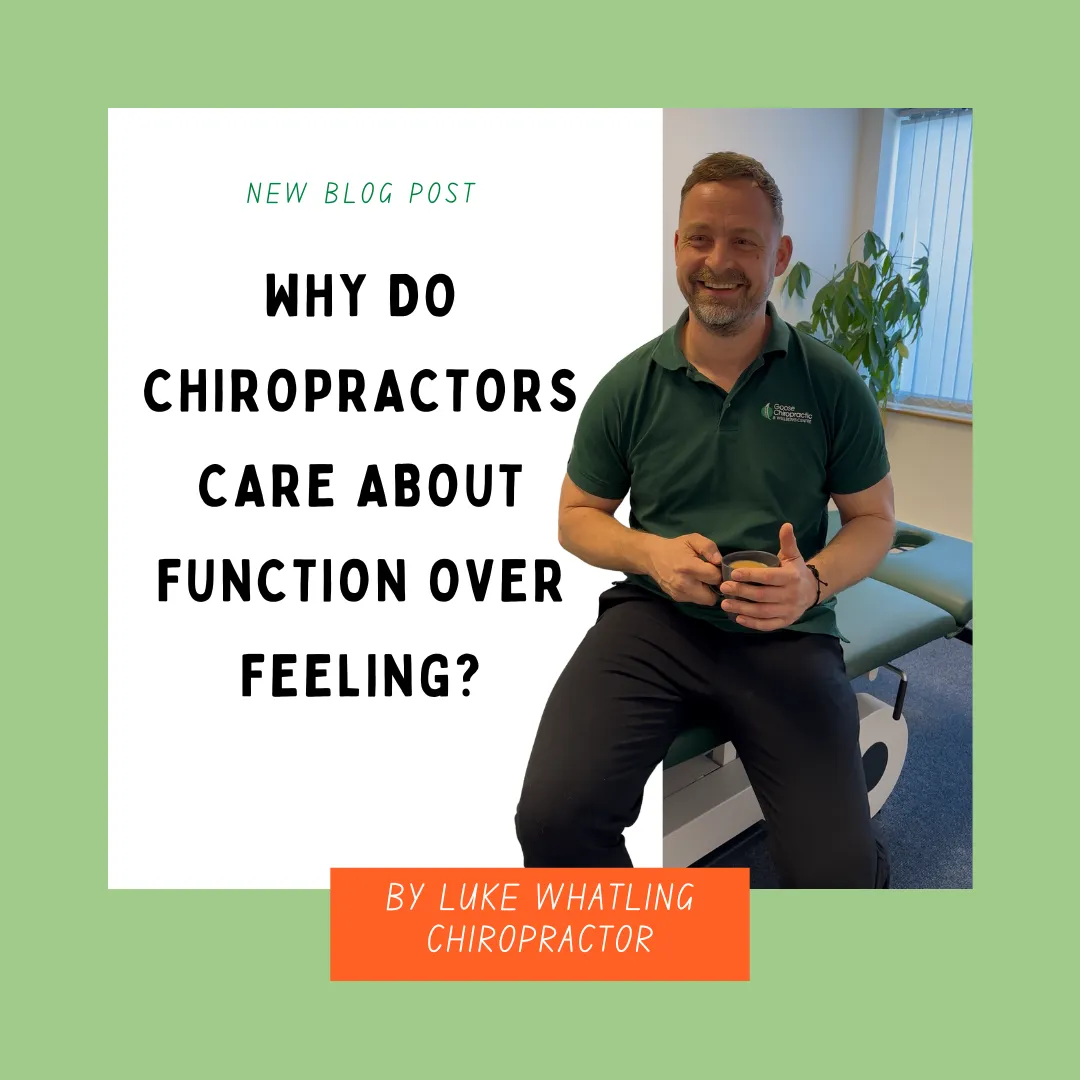
Luke - 1. Function vs feeling
“Pain is the smoke alarm, chiropractic looks for the fire .” - Luke Whatling
Hello everyone, I’m Luke. Some of you may know me, as you get regularly adjusted at Goose Chiropractic and Wellbeing Centre. Others may have seen me around clinic, or not at all!
I wanted to start a blog series answering lots of questions that our wonderful chiropractors here answer on a regular basis, but also to spread the word about how fantastic the profession is and how it can change and facilitate your body to do the things it was meant to. There will be a monthly blog, full of relevant and occasionally some surprising quirky subjects. I hope you enjoy them all.
Firstly, I wanted to touch on pain vs function. This is an extremely important part of what we do as the two are closely related. Most people first come to a chiropractor because something hurts. Back pain, sciatica, stiff necks, headaches. And pain does matter, I know, I’ve been there quite a lot! But if you only focus on pain, you miss the bigger picture of what chiropractic is about.
Pain Is a Signal, Not the Whole Story
Pain is like the warning light on your car dashboard. It tells you something is wrong, but it doesn’t tell you how well the engine is running. In the same way, pain tells you your body is under stress, but it doesn’t measure how well your spine and nervous system are working. And because I like analogies, think of pain as the smoke alarm, chiropractic looks for the fire: the underlying dysfunction. When things function better, your body is more at ease.
Function Is the Foundation
Your spine is incredible. It does more than hold you upright. It moves, protects the spinal cord, and sends constant feedback to your brain. That feedback controls how your body moves, adapts, and heals (more about this in later blogs). When spinal joints stop moving well, the messages to the brain become distorted. That can show up as stiffness, poor muscle control, reduced balance, and eventually pain.
For athletes, that loss of function shows up as slower reaction times or weaker performance. For most of us, it eventually shows up as back pain, sciatica, neck pain or everyday discomfort. In these cases, the underlying issue is the same: function is compromised.
How Chiropractic Fits In
Chiropractic adjustments restore spinal motion and improve the quality of information between your body and your brain. Research shows this can sharpen muscle control, improve balance, and influence reaction time 1,2. For someone with sciatica, that means addressing the underlying dysfunction rather than just masking symptoms. For an athlete, it means moving more precisely and reducing injury risk. One of my earliest memories is being muscle tested by my brother (also a chiropractor! Yes, it’s all we talk about), and he found a weakness or dysfunction in an arm movement. He then adjusted my neck (it’s not scary!) and my arm could move so much better, my muscles were engaging, and I was hooked. This was the beginning of why I became a chiropractor.
Pain Relief vs Long-Term Health
Relieving pain is often the first step, but it is not the end goal. I want to help you feel better AND function better.
That's what I will be talking about in our upcoming FREE health talk, “How to Manage Lower Back Pain and Sciatica” in Rotherham. We will look at practical ways to manage pain, and how chiropractic fits into restoring long-term spinal function. Click here to book your place.
Stay adjusted,
Luke!
Want to book in with Luke? Click here

Kelly DD, Murphy BA, Backhouse DP. Use of a mental rotation reaction-time paradigm to measure the effects of upper cervical adjustments on cortical processing: a pilot study. Journal of Manipulative and Physiological Therapeutics. 2000;23(4):246–251.
DeVocht JW, Schaefer RC, Lawrence DJ. Effect of chiropractic manipulative therapy on reaction time in special operations forces military personnel: a randomized controlled trial. Journal of Chiropractic Medicine. 2019;18(1):35–45.