

Why does my neck hurt when I have a headache?
Have you ever had a headache and noticed that your neck feels stiff, tight or uncomfortable at the same time?
You're not imagining the connection. Sometimes, headaches can actually come from problems in the neck. But it's important to understand that not every headache accompanied by neck pain originates there.
A lot of people automatically assume their headaches are caused by things like stress, dehydration or lack of sleep. And whilst these can all play a part, it's also worth looking at what's happening in your neck, especially if you're regularly experiencing both neck pain and headaches.
How Can Your Neck Cause a Headache?
Your neck does a lot more than just hold your head up. It contains muscles, joints, discs and nerves that all play a role in how your head and neck move and feel.
Something interesting happens with the nerves in your upper neck. They connect with the nerve pathways involved in sensation in your head. Because these pathways interact, pain that starts in certain structures in your neck can actually be felt in your head instead. This is known as referred pain.
When a headache is caused by a problem in the neck, we call it a cervicogenic headache. Which basically means it's a headache that comes from the neck.
You might notice the pain around the back of your head, across your temples or even behind your eyes. Everyone experiences it slightly differently, so it's important to look at the symptoms as a whole rather than just where the pain is.
When I see someone with headaches, one of the first things I want to understand is what their typical day looks like...
I also want to know about stress, previous neck injuries and whether certain activities seem to bring on your headache.
Why? Because all of these things can influence how your neck feels and functions. If you're spending hours in the same position or regularly putting your neck under physical strain, it's worth investigating whether this could be contributing to your symptoms.
For example, you might notice that your neck starts feeling tight towards the end of a working day, followed by a headache that gradually builds. This sort of pattern can give us some useful clues.
That doesn't mean sitting at a desk or looking at your phone is automatically the cause. It's about looking at the bigger picture and understanding what's actually going on.
Are You Doing Anything to Look After Your Neck?
Think about how much you ask of your neck throughout the day.
You might spend hours sitting at work, regularly turn your head to carry out tasks, or lift and move heavy objects. By the time you get home, you might already be experiencing neck discomfort or a headache.
The important thing is to start paying attention to the pattern.
Does your headache tend to appear alongside neck pain? Does moving your neck make your usual headache worse? Does it seem to develop after particular activities?
These are all things I'd want to know when assessing someone with headaches.
For example, if turning your head to one side consistently brings on your usual headache, that's something worth investigating. Similarly, if your neck feels particularly restricted or stiff when your headache appears, it could suggest that the two are connected.
Of course, these things alone aren't enough to confirm that your headache is coming from your neck. We'd need to carry out a full consultation and assess your neck movement, symptoms and medical history to get a better understanding of what's going on.
It's also worth remembering that headaches can have several contributing factors. You might have an issue with your neck, but stress, poor sleep or other things could also be making your headaches worse.
One case I saw in the clinic was someone who could barely move their neck and had a huge headache EVERY DAY!
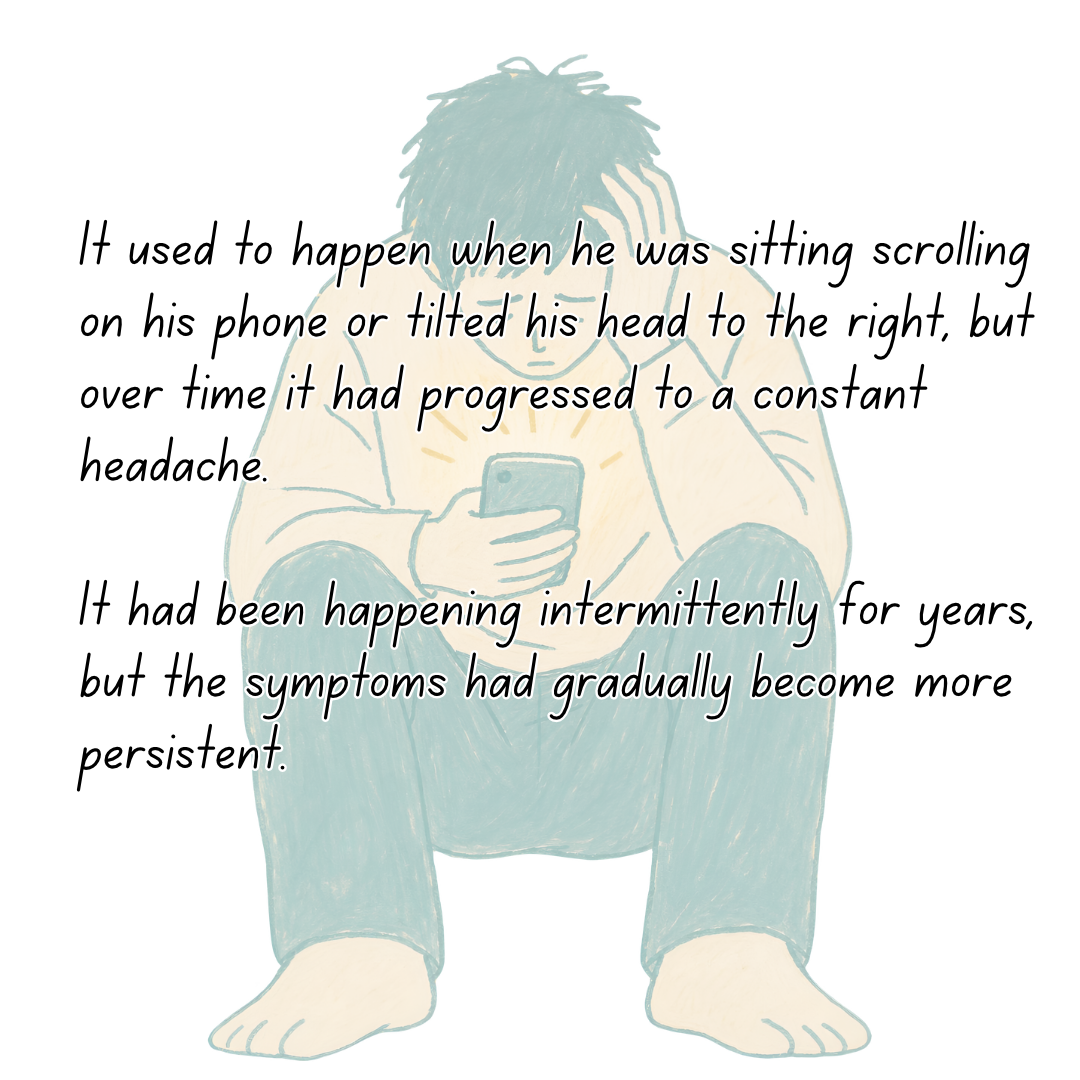
When I first saw him, his neck movement was really restricted, and the headaches were starting to have a big impact on his everyday life.
After working through his care, we started to see some significant improvements.
In his most recent progress review, his neck movement was back to normal, and the only headache he gets now is when he's under a lot of stress.
It's a good example of why I think it's important to look beyond the headache itself. Sometimes, the neck can be a big part of the problem, and addressing it can make a real difference to someone's symptoms.
What Can You Do at Home?
One exercise you can try at home is a chin tuck.
This is a simple exercise that helps work the muscles around your neck and encourages better control of your head position.
To start, make sure your back is upright. If you're sitting down, sit up comfortably with your shoulders relaxed. If you're standing, you can position yourself with your back against a wall.
From here, gently pull your chin backwards, almost as if you're trying to give yourself a double chin.
Your head should glide backwards rather than tipping forwards or downwards. You should feel a gentle movement around your neck.
Hold this position for a couple of seconds before relaxing and returning to your starting position.
The key is to keep the movement controlled. You don't need to force your head backwards or push through any discomfort.
If you're unsure what the movement should look like, click here to be taken to our youtube channel which has a video demonstration on it.
Yong, J.H., Moon, I.Y., Lim, J.S. and Yi, C.H., 2023. Isometric chin tuck exercise with and without scapular postural correction for patients with chronic neck pain: a longitudinal study. International Journal of Therapy and Rehabilitation, 30(4), pp.1-12.
Chua, N.H.L., Suijlekom, H.V., Wilder-Smith, O.H. and Vissers, K.C.P. (2012) ‘Understanding cervicogenic headache’, Anesthesiology and Pain Medicine, 2(1), pp. 3–4. Available at:https://doi.org/10.5812/aapm.3904 (Accessed: 10 October 2026).
National Institute for Health and Care Excellence (NICE) (2012, last updated 2025) Headaches in over 12s: diagnosis and management. NICE guideline CG150. Available at:https://www.nice.org.uk/guidance/cg150/chapter/recommendations (Accessed: 10 October 2026).
Robinson, C.L., Christensen, R.H., Al-Khazali, H.M., Amin, F.M., Yang, A., Lipton, R.B. and Ashina, S. (2025) ‘Prevalence and relative frequency of cervicogenic headache in population- and clinic-based studies: a systematic review and meta-analysis’, Cephalalgia, 45(3). Available at:https://doi.org/10.1177/03331024251322446 (Accessed: 20 October 2026)